sciatica treatment-is it always surgery?
No, no, no!
Sciatica Treatment rarely requires surgical intervention. And research now suggests that surgery should be the last option someone takes having had sciatica.
I discussed in my previous blog what sciatica is and the different types and causes. For the purpose of this blog on sciatica treatment, we will be talking about the management of sciatica that is caused by a DISC herniation. Read on if you want to learn more about the aims of Sciatica Treatment.

reminder of the condition
Sciatica is irritation or compression of the sciatic nerve, which runs down the back of the pelvis, thigh and below the knee into the foot. Symptoms can include pain, pins and needles, numbness or weakness in these areas.
We will be discussing sciatica that is caused by an injury to the intervertebral discs (shock absorbers) in the lower (lumbar) spine. This is the most common cause of sciatica. Injury to the disc can happen through trauma or can happen slowly over time. Disc injuries don’t always result in sciatica, but it can happen when the inner part of the disc protrudes out and puts pressure on the nerve as it leaves the spine. So, any symptoms down the leg aren’t a sign of an issue in the leg, the issue is actually in the disc between two vertebrae in the lower back.
Although this may sound scary, it isn’t as bad as it sounds.
treatment for sciatica isn't as bad as you may think
As an evidence-based osteopath, it’s absolutely imperative to me that I EMPOWER my patients as opposed to SCARE them.
There is a lot of scare-mongering in the world of healthcare. With disc injuries, that can be to make it seem the injury is worse than it is and telling patients they are vulnerable and weak.
I’m not about that. Instead we want to give you positive information and facts that empower you to manage your condition yourself, promote movement and confidence.
Here are four facts about disc injuries that may make you feel a bit better:
1) Pain does NOT equal damage. It means pain. it's temporary.
Now, I’m not writing this to scare you if you don’t have pain. I’m writing this to give you positive information that having a disc injury does not MEAN pain, it means your disc is CURRENTLY painful. Sciatica treatment is aimed to decrease that pain.
This is extremely clinically relevant as someone who currently has sciatica can become pain-free, confident and return to living your life BEFORE your disc ‘heals’. The reasons for this are plentiful and very complicated, and not to cover now, but just take the positive for today!
One high-quality study looked at 3,110 ASYMPTOMATIC people. That means NO sciatica, no lower back pain. And they found disc bulges in:
-30% of people aged 20
-40% of people aged 30
-50% of people aged 40
-60% of people aged 50
-69% of people aged 60
-77% of people aged 70
-84% of people aged 80
That’s over half the population of people aged over 40 will have one or more disc bulges but NO pain! Doesn’t that show how strong and resilient our bodies are, that we can have slight ‘imperfections’ found on MRI scan, but they don’t necessary give us pain. Remember that these people had NO back pain and NO sciatica.
I don’t know about you, but I find that amazing. Pain DOES NOT equal damage!
You can manage your sciatica without fixing your disc.
(Brinjikji et al., 2014)
2) they often heal on their own
There are different types of disc bulge, but we don’t need to go into them as they aren’t clinically relevant to you as it isn’t relevant to your Sciatica Treatment, but we’ll show you the names. They are: protrusion, extrusion and sequestrations.
A review of 31 clinical trials found that:
-96% of disc sequestrations
-70% of disc extrusions
-42% of disc protrusions
…….. SPONTANEOUSLY resolved.
That means that the majority of disc injuries will heal without surgery! But don’t be concerned if you have a protrusion…read back to the first point because loads of people have these without having and pain or dysfunction, all we need to do is make them less painful! You don’t need to heal the disc, you just need to get your function back.
(Chiu et al., 2014)
3) You can keep moving while you have one
One of the best ways to desensitize your sciatic pain (reduce the pain) is to tell your brain that you aren’t as damaged as you think you are by keeping moving. Pain is felt in the brain, and if we can give the brain positive information, it can decrease the sensation of pain as you get on with your every day activities.
This means that movement, as long as you aren’t taking it too far and aggravating your pain, is hugely beneficial and will help you with your pain. It will also make you feel better in yourself and look after your general health in the process, which is always a good thing.
The last thing you should do is bed rest and immobilisation. It’ll do nothing, in fact it often makes the symptoms worse.
4) You've got this/discs don't slip
You can manage your sciatic pain on your own. Your body has amazing healing abilities, it is incredible at protecting you, and as long as you stay calm, keep moving and have a proper rehabilitation programme, you can get back doing what you want to be doing, without pain, without surgery.
Contrary to popular belief…discs don’t slip. Even if you type sciatica on the NHS website, ‘slipped disc’ is the number one cause of sciatica. They don’t slip. They are strong, they are firmly held in place and using this phrase is harmful. Don’t worry about it, throw the phrase in the bin. The term ‘slipped disc’ can negatively effect your Sciatica Treatment.

Sciatica treatments
So now you know all of this positive stuff, I’ll tell you how we manage disc bulges that are causing sciatica at Move Easy Osteopathy.
(1) Promote movement. You’ve got that point by now. Any movement that doesn’t aggravate your pain is great to do. Whether that’s bodyweight squats, walking or swimming, it can all help.
(2) Temporarily reducing aggravating factors. It’s a good idea to temporarily reduce holding positions too long or doing too many movements that make your pain worse. This can help with the sensitization in your brain!
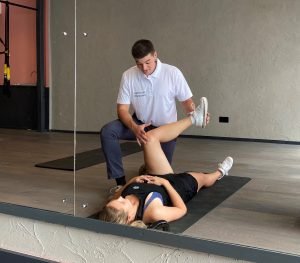
(3) Specific exercises. Again, this is patient-based and unique to you. These specific movements will be prescribed after a thorough examination in order to overcome movement restrictions/stiffnesses, as well as weaknesses. These can be anywhere from your feet to mid-back in order to get you functioning and as strong as possible.
We can also prescribe what’s called ‘neurodynamics,’ which are exercises that specifically mobilise the nerve. They’re great at reducing sciatic pain and telling your nervous system the nerve isn’t damage.
(4) Lifestyle advice. Lifestyle advice will be aimed at giving you all the information you need to manage this at home. Including nutritional, anti-inflammatory, working postures and a list of things you should and should not be doing while in pain.
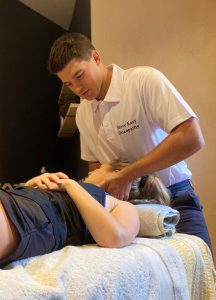
(5) Manual Therapy. Osteopaths are highly trained in performing manual therapy. For sciatica, manual therapy is used to promote movement in your lower back, upper back, hips, knees and legs. We’ll use massage, stretching, maybe some joint manipulations and mobilisations, in order to get your body confident in moving. This is amazing at reducing tension, managing pain and promoting confidence.
NB: What manual therapy CANNOT do: We cannot touch discs, we cannot relocate slipped discs (they don’t slip), and we cannot fix the disc. BUT if you’ve read the rest of this blog you’ll know that you don’t need to do this anyway!
questions?
If you have any questions about any of this, please don’t hesitate to get in touch. I’ll write another blog talking specifically about the best exercises and individual treatments for sciatica.
If you suffer with sciatica, come on in, get it checked out, diagnosed, treated and leave feeling confident and empowered. And with some pain relief, too!
References:
Brinjikji, W., Luetmer, P., Comstock, B., Bresnahan, B., Chen, L., & Deyo, R. et al. (2014). Systematic Literature Review of Imaging Features of Spinal Degeneration in Asymptomatic Populations. American Journal Of Neuroradiology, 36(4), 811-816. doi: 10.3174/ajnr.a4173
Chiu, C., Chuang, T., Chang, K., Wu, C., Lin, P., & Hsu, W. (2014). The probability of spontaneous regression of lumbar herniated disc: a systematic review. Clinical Rehabilitation, 29(2), 184-195. doi: 10.1177/0269215514540919
Stay Connected; Start Movin' Easy
Readers who read this, also read these

What Is Sciatica?
Sciatica is irritation or compression of the sciatic nerve, which runs down the back of the thigh into the foot.

Neck Pain North Finchley
Osteopathy is an effective way of treating neck pain in North FInchley to get you back doing what you love.

Lower Back Pain North Finchley
LBP is actually rarely indicative of serious health conditions. Unless you have ‘red flags,’ which osteopaths are trained to recognise, it’s highly unlikely that LBP is an indicator of something serious.